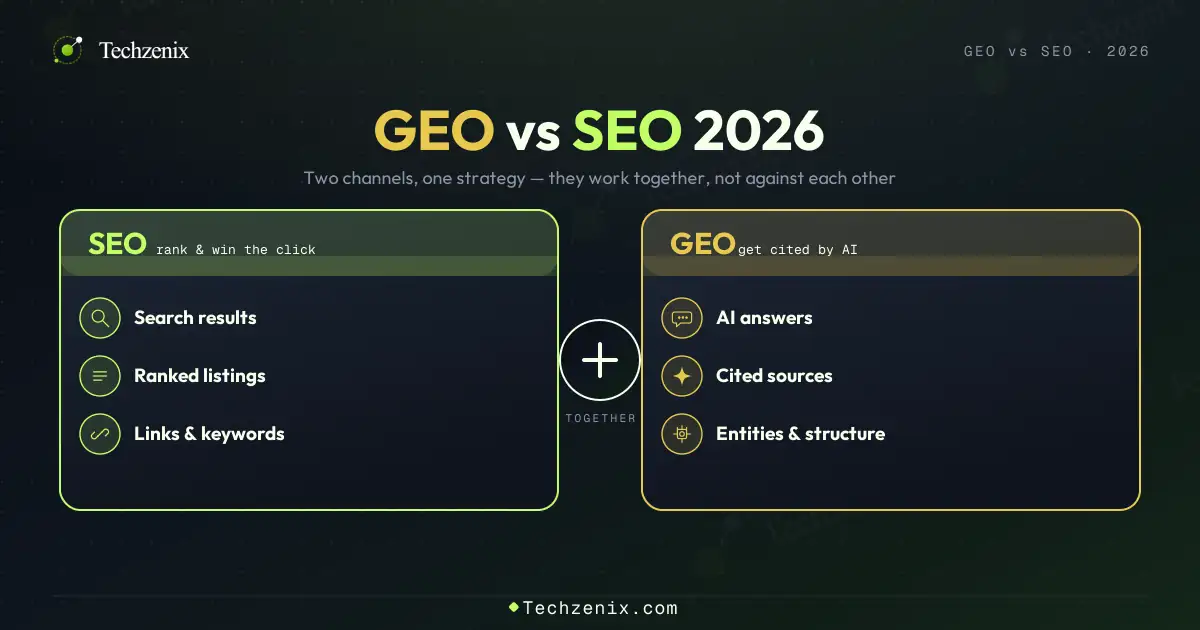
Search Engine Optimization (SEO) optimizes your site to rank in traditional search results like Google and Bing. Generative Engine Optimization (GEO) optimizes your site to be cited by AI answer engines like ChatGPT, Perplexity, Claude, and Google AI Overviews. Both matter in 2026. They serve different jobs and require different tactics.
This guide explains the real differences, where AEO (Answer Engine Optimization) fits into the picture, when to prioritize each discipline, how to blend them into a single strategy, and how to allocate budget between them. Written for marketers, SEO leads, and founders trying to decide where to focus in 2026.
What SEO and GEO Actually Are
Before comparing them, let us get the definitions straight. Most confusion comes from people using both terms loosely.
SEO: Search Engine Optimization
SEO is the practice of optimizing your website to rank in traditional search engine results (Google, Bing, Yahoo, DuckDuckGo). The goal is to earn organic clicks from users searching for what you offer. The core tactics have been stable for two decades: keyword research, content quality, technical setup, backlinks, and user experience.
SEO is still the largest organic channel for most businesses in 2026. Google alone processes billions of queries daily. If you want the full framework, see our complete 2026 technical SEO guide for the foundation.
GEO: Generative Engine Optimization
Generative Engine Optimization is the practice of shaping your content, entity signals, and technical setup so AI systems cite your brand when they generate answers for users. The term was coined by researchers at Princeton and Georgia Tech in 2023. It became mainstream after Google AI Overviews launched in May 2024 and ChatGPT Search launched in October 2024.
GEO covers all major AI answer engines: Google AI Overviews, ChatGPT, Perplexity, Claude, Gemini, and Bing Copilot. If you want the full framework, see our complete Generative Engine Optimization guide which serves as the parent to this comparison.
A Quick Note on AEO
Answer Engine Optimization (AEO) is a related discipline that predates GEO. It focused on optimizing for direct answer features like Google featured snippets and voice assistant answers (Siri, Alexa, Google Assistant). GEO includes and extends AEO. Most modern teams treat AEO as a subset of GEO in 2026 rather than a separate discipline.
The Real Difference Between GEO and SEO
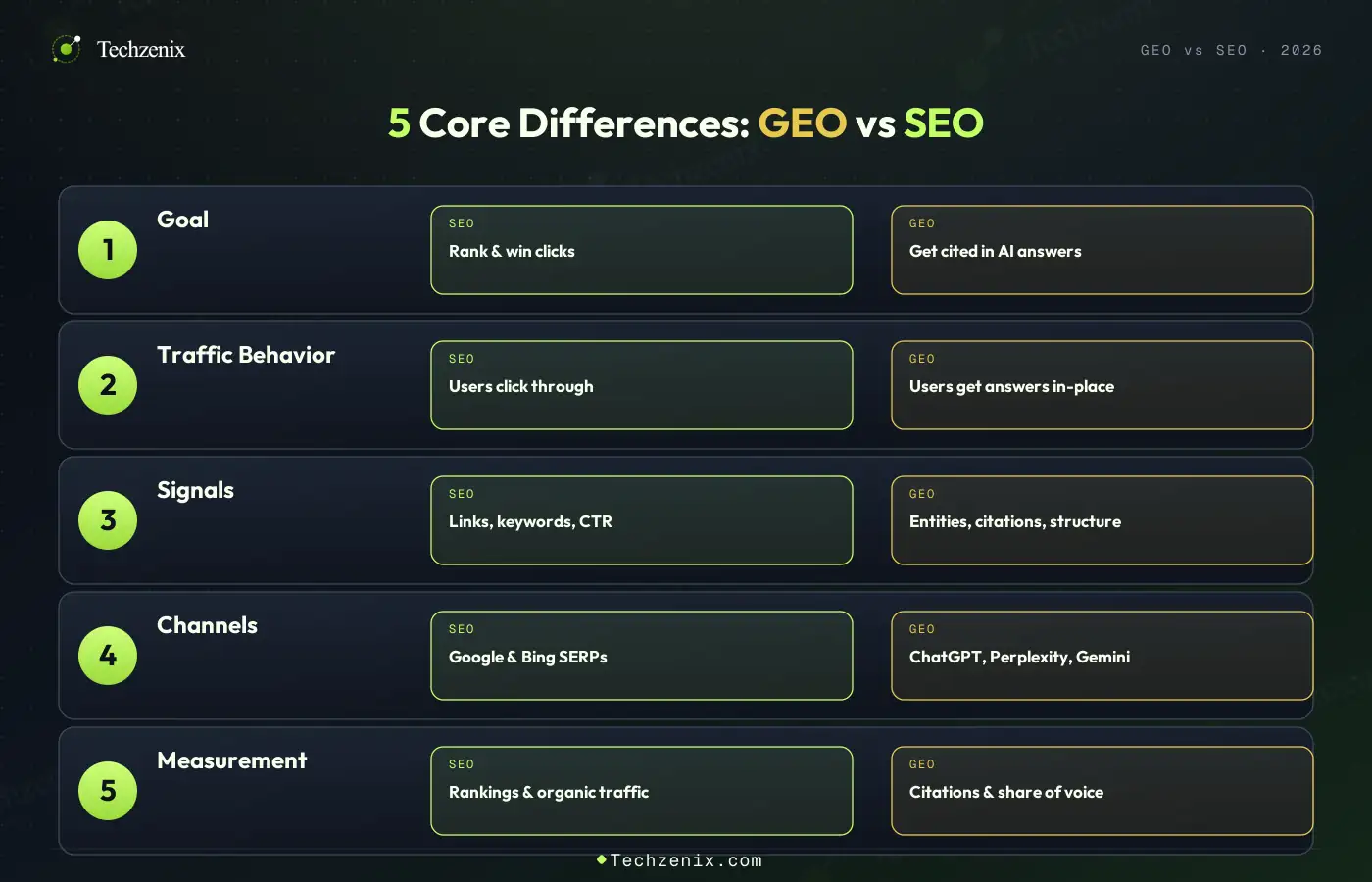
SEO and GEO share ancestry but diverge in five meaningful ways. Understanding these differences prevents wasting effort on tactics that do not apply.
Difference One: What You Are Optimizing For
SEO optimizes for search result rankings that drive clicks. Success is measured in organic traffic and conversions from that traffic. GEO optimizes for citation inclusion in AI generated answers. Success is measured in brand mention share, not always clicks.
Difference Two: The Traffic Behavior Assumed
SEO assumes users click through to your website. GEO assumes users read the AI generated answer and may never click. This changes what counts as a win. A GEO citation is visibility in front of the user, even without the click. Some teams struggle to accept this shift because click based metrics have been the standard for two decades.
Difference Three: What Signals Matter Most
SEO weights backlinks, keyword targeting, technical health, user experience, and content quality. GEO weights content structure (chunkable sections), direct answer paragraphs, author authority, freshness, entity signals, and structured data. Some signals overlap (content quality, technical health) but the emphasis differs.
Difference Four: The Channels You Cover
SEO covers Google, Bing, and other traditional search engines. GEO covers Google AI Overviews, ChatGPT, Perplexity, Claude, Gemini, and Bing Copilot. GEO requires coverage across multiple AI systems with different mechanics, not just one search engine.
Difference Five: How You Measure Success
SEO uses organic traffic, keyword rankings, click through rates, and conversions from organic. GEO uses citation share, mention frequency across AI engines, share of voice against competitors, and prompt coverage. Traditional analytics do not show GEO performance. Measurement requires dedicated tools or manual tracking.
Side
by Side Comparison Table
|
Dimension |
SEO |
GEO |
|
Primary Goal |
Rank in search results, earn clicks |
Get cited in AI generated answers |
|
Success Metric |
Organic traffic and conversions |
Citation share and mention frequency |
|
Channels Covered |
Google, Bing, Yahoo, DuckDuckGo |
ChatGPT, Perplexity, Claude, Gemini, AI Overviews |
|
Primary Signals |
Backlinks, content quality, technical SEO, user experience |
Chunking, direct answers, author authority, freshness, entities |
|
Traffic Assumption |
User clicks through to your site |
User reads answer, may never click |
|
Time to Results |
3 to 12 months for measurable rankings |
2 to 8 weeks for citation changes |
|
Cost Range |
Established range, mature market |
Emerging category, wider price variance |
|
Measurement Tools |
Google Search Console, Ahrefs, Semrush |
Otterly, Peec AI, Profound, manual tracking |
|
Content Structure Focus |
Long form, keyword optimized, comprehensive |
Chunkable sections, direct answers, structured |
|
Buyer Journey Stage |
Covers all stages (TOFU, MOFU, BOFU) |
Strong at TOFU research and initial consideration |
Does GEO Replace SEO?
Short answer: no. GEO extends SEO, it does not replace it. The two disciplines serve different jobs and both matter in 2026.
Longer answer: the panic about SEO dying every time a new search technology launches has been happening for 20 years. Voice search was supposed to kill SEO. Featured snippets were supposed to kill SEO. AI Overviews are supposed to kill SEO. Every time, SEO adapted rather than disappeared. GEO is following the same pattern.
Three things point to this being an extension rather than a replacement:
● AI answer engines use search index data to select sources. Your rank still matters. If Bing does not index you, ChatGPT cannot cite you. If Google ranks you page 2, AI Overviews rarely include you.● Traditional search still drives massive traffic to commercial and transactional queries where users need to compare, buy, or take action. AI Overviews are less common on these queries.
● The technical foundation (crawlability, page speed, structured data, mobile friendliness) matters for both SEO and GEO. Investment in the foundation pays for both.
What is changing: informational queries now often generate zero clicks because the answer sits in the AI Overview. If your business depended entirely on informational traffic, the shift hurts. If your business also captures commercial and transactional queries, the shift is manageable.
How the Two Work Together in 2026
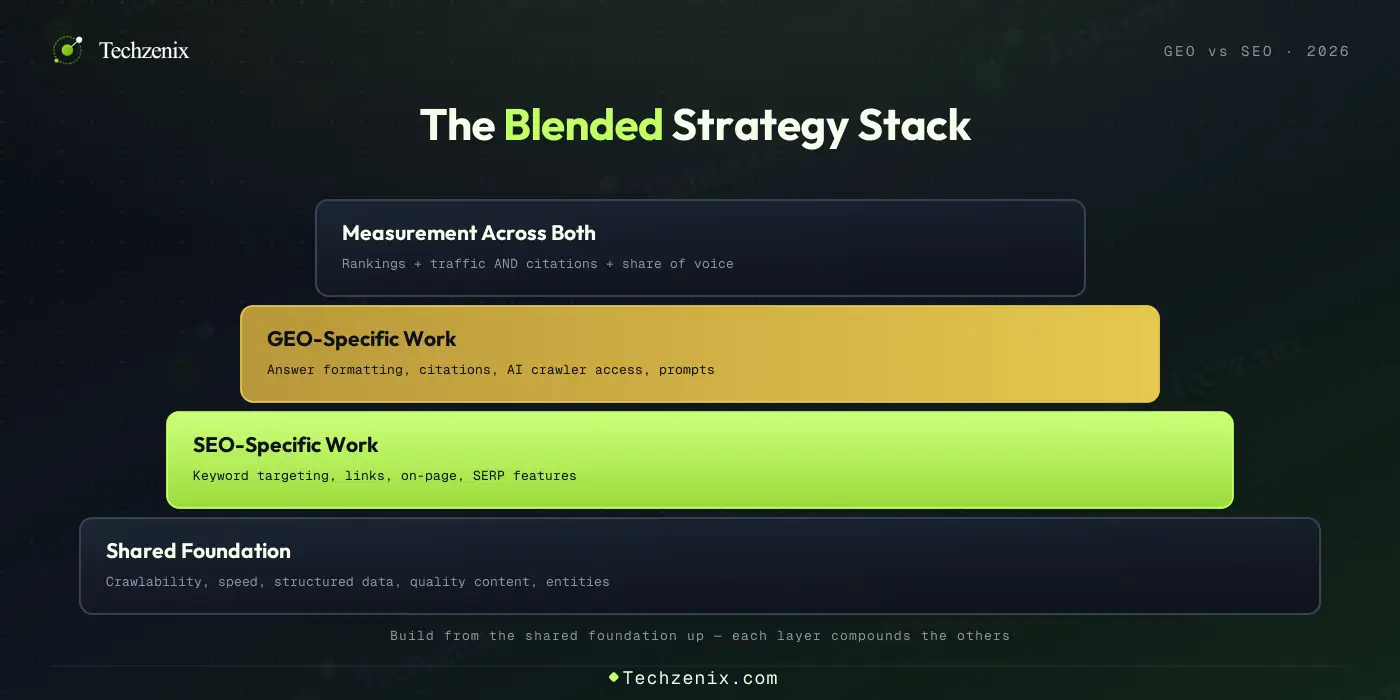
The winning approach in 2026 is a blended strategy that treats SEO and GEO as layers of the same system rather than competing disciplines. Here is how our team structures blended engagements.
Layer One: Shared Foundation
Technical setup, site architecture, crawlability, page speed, and structured data serve both SEO and GEO. Never treat these as separate work streams. One audit, one implementation, benefits stacking.
Layer Two: SEO Specific Work
Backlink acquisition, keyword targeting, long form content, and comprehensive topic coverage remain SEO focused. These build ranking authority which then feeds GEO citation eligibility.
Layer Three: GEO Specific Work
Content chunking, direct answer optimization, author byline strengthening, entity building (Wikidata, schema), and AI crawler access. This layer sits on top of good SEO to unlock citation visibility.
Layer Four: Measurement Across Both
Track SEO metrics (rankings, traffic, conversions) and GEO metrics (citations, mention share, prompt coverage) in one dashboard. Analyze how they influence each other. Pages with strong SEO often become the best GEO performers because they are already indexed and trusted.
Budget Allocation: How Much for SEO vs GEO
This is the practical question most teams ask. There is no single right answer, but here are the frameworks we use with clients based on business type.
For Established Businesses With Strong SEO Presence
If you already rank well and have a mature SEO operation, allocate 70 percent to maintaining and growing SEO, 30 percent to GEO layer additions. The 30 percent primarily covers chunking, direct answers, entity building, and AI citation tracking. This is the fastest path to visibility because your SEO foundation is already there.
For Growing Businesses Building SEO
If SEO is still building, allocate 80 percent to SEO foundation and 20 percent to GEO. Focus GEO work on chunking new content correctly and setting up crawler access. Bigger GEO investment before SEO ranks pays back is usually premature. Fix the foundation first.
For Businesses With Weak or No SEO
If you have no meaningful SEO presence, allocate 90 percent to SEO fundamentals and 10 percent to setting up GEO measurement. Attempting GEO without SEO ranking is like trying to be quoted in a book you cannot get published. Get the foundation first.
For Businesses Targeting High AI Search Verticals
Some verticals (SaaS, B2B services, research heavy queries) see much higher AI search intermediation than others. If your buyers heavily use ChatGPT and Perplexity for research, tilt more toward GEO earlier: 60 percent SEO, 40 percent GEO. This reflects the reality that AI citations may drive more revenue than clicks for your specific audience.
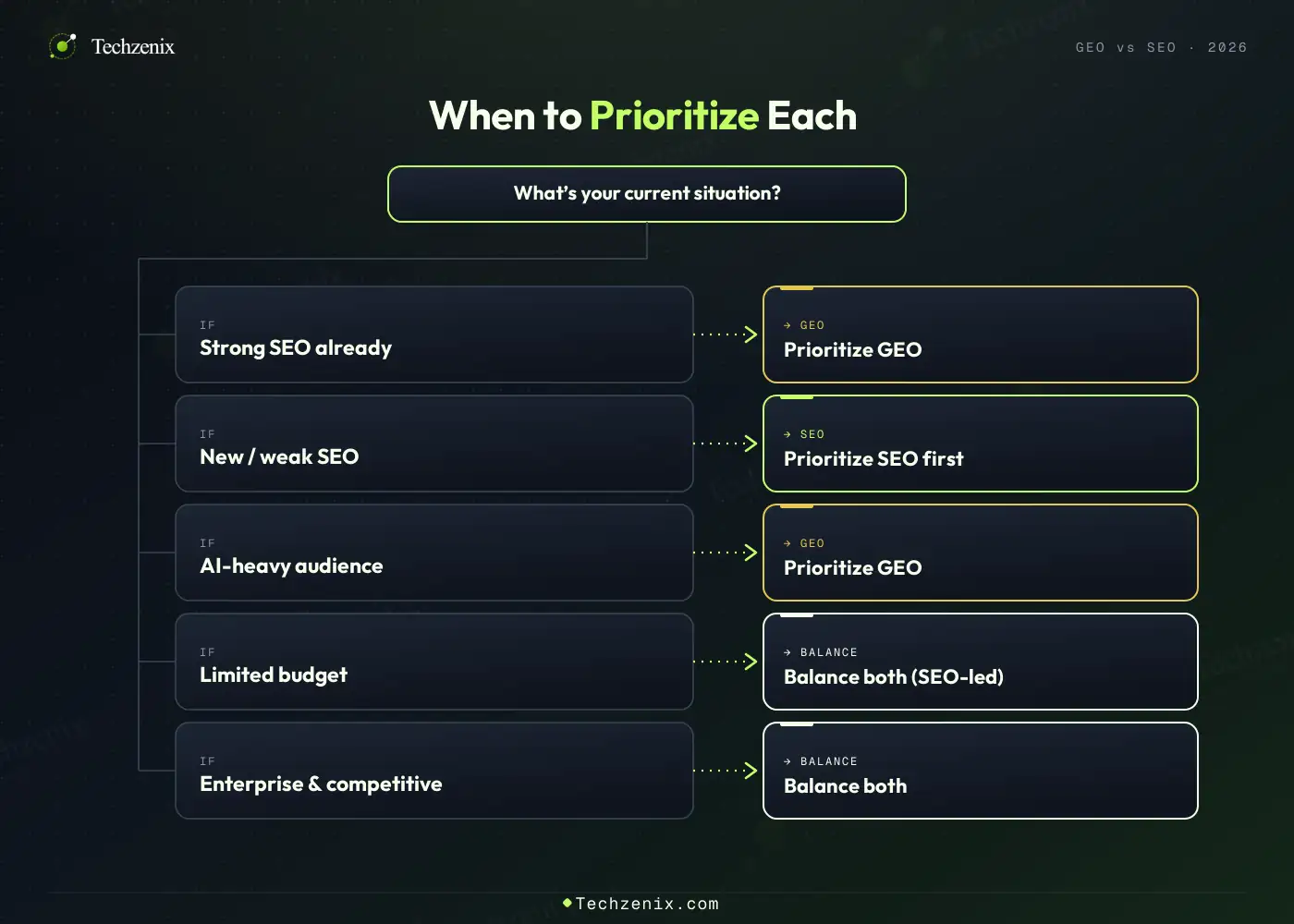
When to Prioritize Each
Beyond budget, timing matters. Here is a decision framework for when to lean into SEO versus GEO first.
Prioritize SEO First When
● You have no organic presence and need to build indexing foundation● Your commercial and transactional queries drive most revenue
● Your industry has strong Google intent (retail, local services, transactional)
● Your team has no experience with AI citation tracking
● Your competitive set is not yet doing GEO seriously
Prioritize GEO First When
● You already rank well in Google and want faster incremental wins● Your audience is heavy in AI search adoption (B2B, SaaS, technical buyers)
● Your industry has high informational query volume that AI Overviews are absorbing
● Your competitors are already showing up in AI answers and you are not
● You have documented AI search referrals or citations already
Metrics for SEO and GEO
Different disciplines require different metrics. Here is what each tracks and why.
Core SEO Metrics
● Keyword rankings across target keyword set● Organic traffic segmented by intent (informational, commercial, transactional)
● Click through rate from search results
● Conversions from organic attributed to specific pages and queries
● Backlink profile growth in referring domains and quality
● Technical health scores from tools like Ahrefs or Semrush
Core GEO Metrics
● Citation share across ChatGPT, Perplexity, Claude, Gemini● Mention frequency in AI generated answers for target prompts
● Share of voice against named competitors
● Prompt coverage percentage of tracked prompts where brand appears
● AI Overview presence in Google Search for target queries
● AI referral traffic (smaller than organic click traffic but rising)
Common Mistakes When Balancing SEO and GEO
Mistake One: Treating Them as Competing Disciplines
Some teams argue about whether SEO or GEO is more important. This misses the point. They are layers of the same system. Debating priority wastes time better spent building both.
Mistake Two: Skipping SEO Foundation to Chase GEO
The excitement around AI search leads some teams to skip SEO and jump straight to GEO tactics. This fails because GEO relies on search index data. No rank means no citations. Fix the foundation first.
Mistake Three: Measuring Only Clicks
Traditional click based metrics miss the GEO citation dimension. A brand mentioned in AI answers builds recall even without a click. Add mention share metrics to your measurement or you undercount GEO value.
Mistake Four: Optimizing for One AI Engine Only
Some teams focus exclusively on ChatGPT and ignore Perplexity, Claude, and Gemini. Each engine has different weighting. A blended GEO strategy covers all major surfaces, not just the biggest one.
Mistake Five: Assuming GEO Kills Every SEO Tactic
Backlinks, keyword targeting, and content depth still matter. They matter for SEO rankings which feed GEO eligibility. Abandoning them because "AI is different" hurts both fronts.
Where to Go From Here
The GEO vs SEO framing is misleading if taken as a choice. They are not competitors. They are layers of a single system for earning visibility in 2026. Teams that treat them as one system win. Teams that pick sides miss opportunity on the side they abandon.
Start with a clear picture of
where you sit today. If SEO is weak, invest there first. If SEO is mature,
layer GEO on top for faster incremental wins. If your vertical is high AI
search adoption, tilt earlier toward GEO. Either way, run them together, not
separately.
The one thing to do after reading this
Say what happens when they act, not what you want them to click.
No obligation a conversation, not a pitch.Frequently asked questions
Is GEO replacing SEO in 2026?+
No. GEO extends SEO. Traditional search still drives significant traffic and still feeds AI answer engines with source data. Both disciplines matter and should run together.
What is the difference between GEO and AEO?+
Answer Engine Optimization (AEO) is older and focused on direct answer features like Google featured snippets and voice assistant responses. Generative Engine Optimization (GEO) is newer and broader. It covers full AI generated answers from ChatGPT, Perplexity, Claude, and Gemini. Most teams treat AEO as a subset of GEO in 2026.
Do I need both SEO and GEO for my business?+
For most businesses, yes. SEO covers Google organic traffic which remains large. GEO covers emerging AI search which is a growing share of buyer research. Skipping either leaves visibility on the table.
How is budget usually split between SEO and GEO?+
It depends on your maturity. Established SEO players typically allocate 70 percent SEO and 30 percent GEO. Growing brands allocate 80 percent SEO and 20 percent GEO. Businesses without an SEO foundation allocate 90 percent SEO and 10 percent GEO measurement. High AI search verticals can shift toward 60 percent SEO and 40 percent GEO.
Which is faster to show results, SEO or GEO?+
GEO shows measurable citation changes in 2 to 8 weeks for pages that already rank well. SEO ranking gains typically take 3 to 12 months. GEO is faster in the short term but requires the SEO foundation to be in place first.
Can I do GEO without doing SEO?+
Practically no. AI answer engines source from search index data. Pages that do not rank in Bing or Google rarely get cited in AI answers. The exceptions are highly authoritative sources like Wikipedia and government sites. For most brands, SEO ranking is the entry ticket to GEO citation.
Do the same tools cover both SEO and GEO?+
Increasingly yes. Ahrefs and Semrush both added GEO tracking features through 2024 and 2025. Specialized tools like Otterly, Peec AI, and Profound cover GEO with more depth than integrated platforms. Most teams use one full stack tool plus one specialized GEO tracker.
Should small businesses focus on SEO or GEO first?+
SEO first, almost always. Small businesses typically have limited resources and need to build organic presence before AI citations become achievable. Focus SEO on capturing local and commercial queries, then add GEO layer once ranking is established.

Ali Hamza is an SEO specialist and digital marketer with 7+ years of experience in SEO, content strategy, WordPress, and online growth marketing. He shares practical insights and industry-based strategies focused on improving search visibility, user experience, and long-term organic growth.