ChatGPT now has over 200 million weekly active users. When those users ask business, research, or shopping questions, ChatGPT Search generates an answer and cites a handful of sources. If your brand shows up in those citations, you get visibility that pure Google rankings no longer guarantee. If you do not, you are invisible in a channel where a growing share of buyer research now happens.
This guide covers how ChatGPT actually picks sources, the content patterns it quotes most often, the technical setup you need to be citation eligible, and a 30-day plan to move the needle. It is written for marketers, SEO leads, and founders who want practical actions instead of definitions.
Why ChatGPT SEO Matters in 2026
Most SEO teams still measure success by Google rankings. That worked when Google was the only destination for buyer research. In 2026, buyers split their research across Google, ChatGPT, Perplexity, and Claude. ChatGPT alone captures a significant chunk of that attention because of scale.
The numbers matter. ChatGPT reached 200 million weekly active users in late 2024, per OpenAI's public statements. That base has grown through 2025 and 2026. When ChatGPT Search launched in October 2024, it opened a new front where brands could be cited or ignored. Every citation is a mention in front of a buyer at the moment of research. Every missed citation is a competitor getting that mention instead.
ChatGPT SEO is a subset of the broader Generative Engine Optimization discipline. If you want the full framework across all AI engines, start with our generative engine optimization guide. This post focuses specifically on ChatGPT tactics.
How ChatGPT Actually Picks Its Sources
Most guides skip this section. It is the most important one, because everything else is guesswork if you do not understand the mechanism.
ChatGPT Search works in three modes depending on the query:
Mode One: Retrieval From Training Data
For questions that do not require fresh information, ChatGPT answers from its training data. This is not a citation source in the traditional sense but it still matters. If your brand is well represented in the datasets that trained the model (through mentions across the web, structured entity data, and authoritative citations), you may be surfaced even without a live search.
The practical takeaway: entity building work you do today shapes your brand presence in the next training cycle. This is a long term investment, not a quick win.
Mode Two: Live Web Search Through SearchGPT
When ChatGPT determines that the query needs current information, it triggers a web search using OpenAI's SearchGPT crawler and results from Bing. The mechanism is roughly:
The model rewrites the user's question into one or more search queries
Those queries hit the search index (primarily Bing)
The model selects a handful of results to open and read
It extracts relevant content chunks and synthesizes an answer
The answer cites the sources it drew from
This means: if you are not indexed in Bing, you cannot be cited by ChatGPT Search. If you are indexed but rank poorly, you rarely get selected. If your page is heavy on JavaScript and light on server rendered HTML, the extraction step struggles.
Mode Three: Deep Research
ChatGPT's Deep Research feature (launched 2025) runs multi step research across many sources for complex questions. It cites significantly more sources per answer than standard ChatGPT Search. The mechanism is similar but with more searches and more page reads.
Practical implication: Deep Research is where thorough authoritative content gets cited most heavily. Definitional stub content rarely wins here.
The Content Patterns ChatGPT Quotes Most
Search Engine Land published a study in 2025 analyzing over one million prompts to identify what content gets cited. Their findings match what our team sees in day to day client work. The patterns below are what actually gets pulled.
Pattern One: Direct Answer Paragraphs
ChatGPT prefers content that answers the question in the first paragraph. Not "here is some background context, then we will get to the answer" but "the answer is X. Here is why." These get cited far more often than meandering intros.
Practical rule: every H2 section that poses a question should have a direct answer in the first 40 words of the section.
Pattern Two: Structured Lists and Tables
Numbered lists, bulleted steps, and comparison tables get cited disproportionately because they are easy to extract. A page with clear ordered steps gets cited more than the same information written as flowing prose.
Pattern Three: Specific Numbers and Data
Content with specific statistics, percentages, and data points gets pulled more often than generic claims. "Studies show" loses to "a 2025 Bain study of 2,400 B2B buyers found that 40 percent use AI assistants."
If you have primary research, publish it. First party data almost always beats aggregated commentary in citation odds.
Pattern Four: Attributed Expert Quotes
Direct quotes from named experts, with their credentials, get cited often. This is why author bylines with clear credentials matter. A quote from "Ali Hamza, Head of SEO at Techzenix" carries more citation weight than the same sentence with no attribution.
Pattern Five: Comparison Structure
When users ask "X vs Y" questions, ChatGPT prefers pages that present the comparison in structured form. A page with a comparison table gets cited more than a page that describes both options in prose.
The Bing Indexing Foundation Most SEO Teams Skip
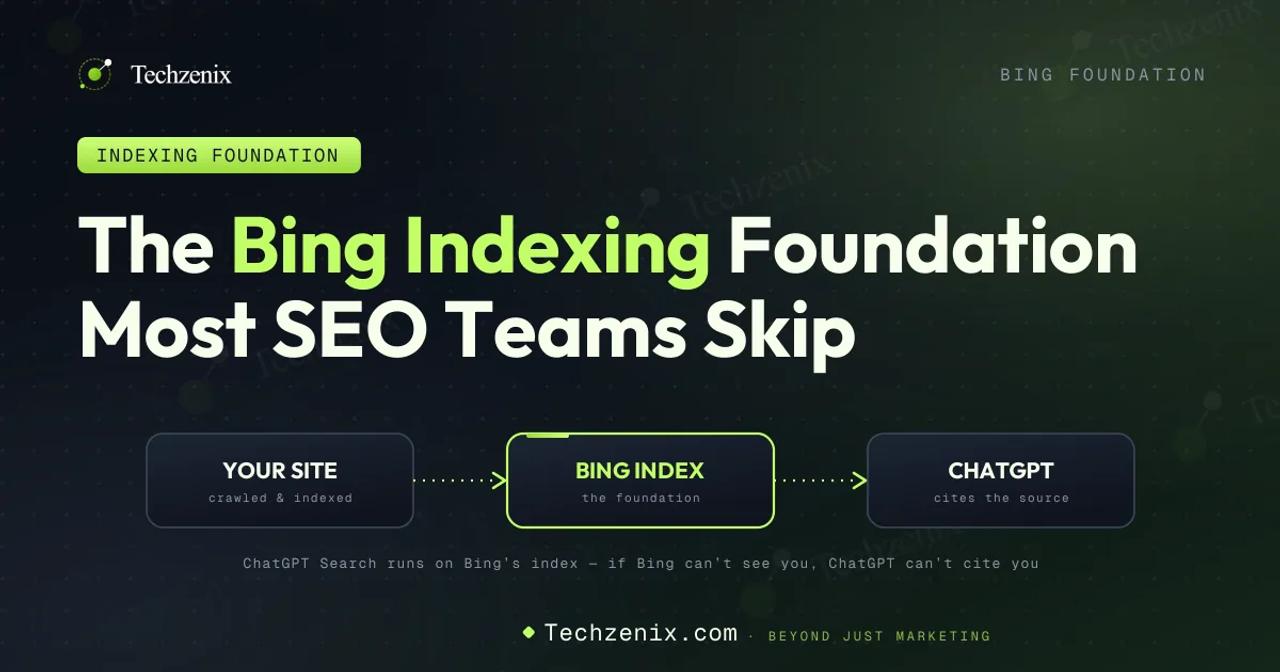
Every guide that focuses only on ChatGPT tactics without mentioning Bing misses half the equation. ChatGPT Search relies heavily on Bing's index. If Bing does not know about your page, ChatGPT usually cannot cite it.
Setting Up Bing Correctly
Three things every site needs. If you have not done these, do them this week.
Verify your site in Bing Webmaster Tools. You can import your Google Search Console configuration to speed this up.
Submit your sitemap in Bing Webmaster Tools. Bing does not always discover sitemaps as fast as Google.
Enable IndexNow. IndexNow is a Bing supported protocol that lets you push new and updated URLs to search engines instantly. Most modern CMS platforms support it through plugins.
Improving Bing Rankings Specifically
Bing weights some signals differently than Google. Content that ranks in Google often ranks in Bing too but with adjustments. Key differences to note:
Bing weights exact match keywords in title tags more heavily than Google does
Bing responds faster to freshly submitted content, especially through IndexNow
Bing considers social signals (shares, mentions) more than Google
Bing rewards clean URL structures and clear internal linking
Our technical SEO audit checklist includes a Bing specific section covering these differences.
Crawler Access: Let ChatGPT Read Your Content
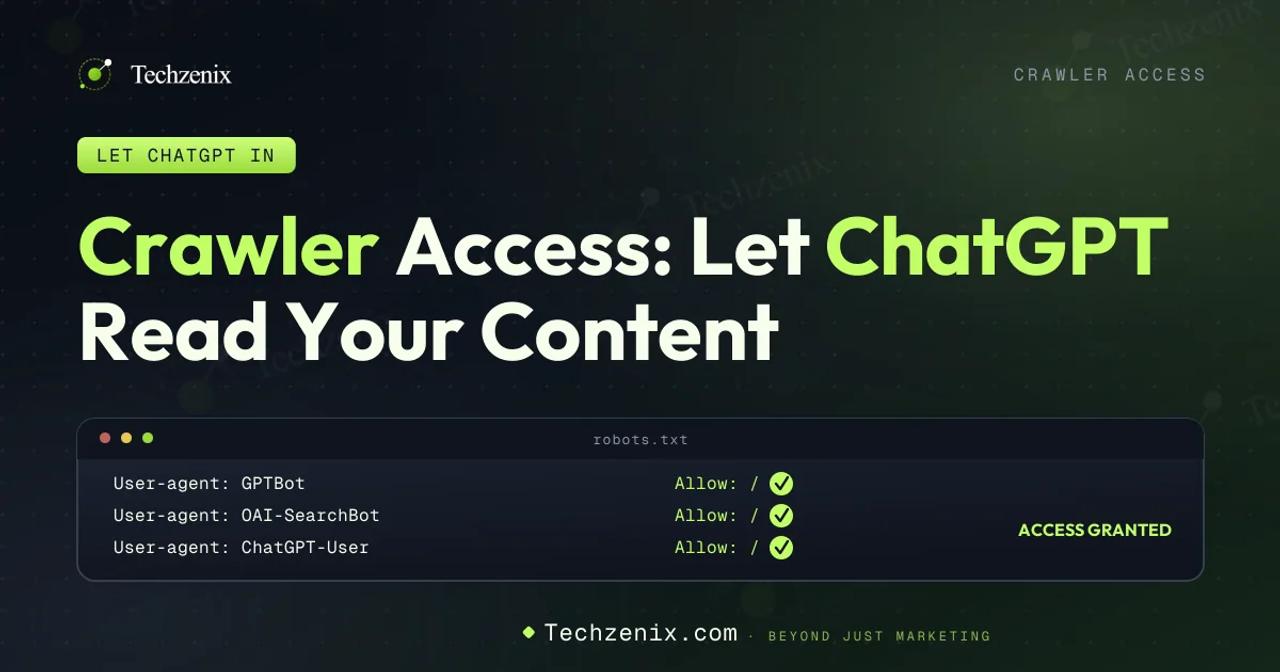
ChatGPT uses two distinct user agents that need to be considered separately in your robots.txt:
GPTBot
OpenAI's crawler used for training data collection. Allowing this crawler means your content may be used in future model training, which can strengthen your brand's presence in ChatGPT's underlying knowledge.
OAI-SearchBot
The crawler used by SearchGPT for live web search. This is the one that fetches your content when ChatGPT Search generates an answer. Blocking this crawler means you cannot be cited in real time responses.
The Recommendation
For most brands whose growth benefits from visibility, allow both crawlers. If you sell content or have specific concerns about training data use, you can allow OAI-SearchBot while blocking GPTBot. This gets you real time citations without your content going into training sets.
A minimal robots.txt configuration that allows both:
User-agent: GPTBot Allow: /User-agent: OAI-SearchBot Allow: /
Full user agent documentation is available in OpenAI's public bot page.
Content Optimization: What to Do Page by Page
Here is the exact page level checklist our team uses when optimizing for ChatGPT citations.
Rewrite Your First Paragraph
For every page you want cited, the first paragraph should directly answer the question the page targets. Delete opening context, background, and setup sentences. Start with the answer.
Structure H2 Sections as Standalone Answers
Every major section should stand alone. If a reader landed only on that section, would it deliver value? If not, restructure. ChatGPT often extracts single sections rather than reading entire pages.
Add FAQ Schema
A FAQ section with FAQPage schema at the bottom of every important page catches long tail questions. Aim for 6 to 12 questions covering variations of the main topic.
Cite Primary Sources
For every statistic, research finding, or non obvious claim, link to the primary source. ChatGPT weights pages that cite well as more credible themselves.
Include Author Attribution
Every page needs a named author with credentials. Not "By the Marketing Team" but a real person with a bio. Link to a LinkedIn profile. This signals to ChatGPT that a real expert stands behind the content.
Update Publication and Modified Dates
Include both dates in schema and visibly on the page. ChatGPT prefers recently updated content for time sensitive queries. A three month old refresh often outperforms a two year old original.
Add Comparison Tables Where Applicable
For comparison and versus content, use HTML tables. The extraction step handles tables efficiently. Prose comparisons work but tables win.
How to Measure ChatGPT Citations
Traditional SEO analytics do not show ChatGPT citations. You need a separate measurement approach.
Manual Tracking (Best Starting Point)
Build a simple spreadsheet with your top 20 buyer research queries. Once a week, run each query through ChatGPT (both the standard model with Search enabled and Deep Research for a few). Log which sources get cited and whether your brand appears.
This is tedious. It is also the ground truth. No automated tool matches manual tracking for accuracy, and doing it yourself builds intuition for what works.
Automated Tools
Several tools now automate ChatGPT citation tracking. The category is young and changing quickly, but a few options are worth knowing:
| Tool | What It Tracks | Best For |
|---|---|---|
| Otterly.AI | Brand mentions across ChatGPT, Perplexity, Gemini, Claude | Teams needing multi-engine coverage |
| Peec AI | AI citation share of voice against competitors | Competitive benchmarking |
| Profound | AI answer engine analytics | Enterprise budgets with dedicated GEO focus |
| Ahrefs Brand Radar | Brand mentions in AI-generated responses | Teams already using Ahrefs |
| Semrush AI Toolkit | AI visibility tracking and prompt analytics | Teams already on Semrush |
Our recommendation: start with manual tracking. Only invest in a tool once you have a baseline and know what you are measuring. Buying tools before understanding the problem usually wastes budget.
Six Mistakes That Kill ChatGPT Citation Odds
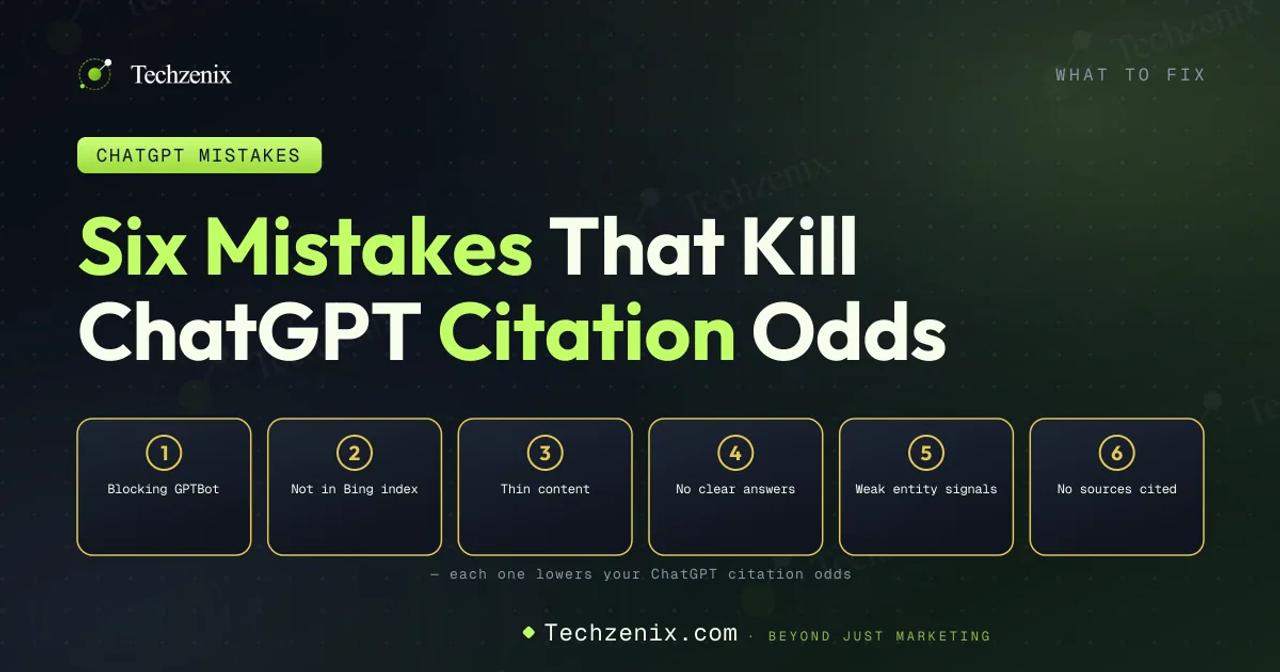
Mistake One: Ignoring Bing Completely
Teams optimize for Google, forget Bing exists, then wonder why ChatGPT never cites them. Bing indexing is the entry ticket to ChatGPT Search citations.
Mistake Two: JavaScript Heavy Pages With No Server Rendering
If your content only renders after JavaScript executes, ChatGPT's extraction step often misses it or gets it wrong. Server side rendering or static generation solves this. If you use a React or Vue framework, verify that critical content is in the initial HTML response.
Mistake Three: Padding the Intro
Long meandering opening paragraphs signal to ChatGPT that the answer is buried. Cut everything before the direct answer.
Mistake Four: Anonymous Authorship
Pages with no named author or generic bylines get cited less. Every important page needs a real person with credentials attached.
Mistake Five: Old Content Not Refreshed
Content published two years ago and never updated gets cited less than fresh content, even when the older content has more backlinks. Refresh your top pages regularly.
Mistake Six: Blocking Crawlers Then Complaining About Invisibility
Some teams block OpenAI crawlers early in the panic phase, then wonder why they never appear in ChatGPT citations. If you want the visibility, allow the crawlers.
Mistake One: Ignoring Bing Completely
Teams optimize for Google, forget Bing exists, then wonder why ChatGPT never cites them. Bing indexing is the entry ticket to ChatGPT Search citations.
Mistake Two: JavaScript Heavy Pages With No Server Rendering
If your content only renders after JavaScript executes, ChatGPT's extraction step often misses it or gets it wrong. Server side rendering or static generation solves this. If you use a React or Vue framework, verify that critical content is in the initial HTML response.
Mistake Three: Padding the Intro
Long meandering opening paragraphs signal to ChatGPT that the answer is buried. Cut everything before the direct answer.
Mistake Four: Anonymous Authorship
Pages with no named author or generic bylines get cited less. Every important page needs a real person with credentials attached.
Mistake Five: Old Content Not Refreshed
Content published two years ago and never updated gets cited less than fresh content, even when the older content has more backlinks. Refresh your top pages regularly.
Mistake Six: Blocking Crawlers Then Complaining About Invisibility
Some teams block OpenAI crawlers early in the panic phase, then wonder why they never appear in ChatGPT citations. If you want the visibility, allow the crawlers.
Your 30 Day ChatGPT SEO Starter Plan
A focused plan for teams starting ChatGPT SEO work. Adjust to your resources.
Week 1: Audit and Baseline
- List your 20 most important buyer research queries
- Run each through ChatGPT with Search enabled
- Log which sources get cited and whether your brand appears
- Verify your site in Bing Webmaster Tools if not done
- Check robots.txt against GPTBot and OAI-SearchBot
Week 2: Technical Foundation
- Submit sitemap to Bing Webmaster Tools
- Set up IndexNow through your CMS
- Verify critical content renders in server side HTML
- Update robots.txt to allow relevant crawlers
Week 3: Content Rework
- Rewrite the first paragraph of your top 10 pages to directly answer the target question
- Add FAQ sections with FAQPage schema to pages that lack them
- Update author bylines and add credentials
- Refresh publication and modified dates on refreshed content
Week 4: Measure and Iterate
- Rerun the top 20 queries and compare against Week 1 baseline
- Log which improvements moved citations and which did not
- Plan the next 30 days based on what worked
Where to Go From Here
ChatGPT SEO is not a passing trend. AI assistants are now a permanent research channel. Every quarter that passes without work here is share of consideration lost to competitors who did the work.
If you have capacity in house, the 30 day plan above is a proven starting point. If your team is at capacity or you want to move faster, this is exactly what our practice handles day to day.
Ready to get your brand cited by ChatGPT?
Techzenix runs full AI search optimization engagements for brands ready to show up in ChatGPT, Perplexity, Claude, and Google AI Overviews. We handle everything from technical setup to citation tracking. Learn more about our generative engine optimization services or request a proposal .
Frequently asked questions
Does ChatGPT use Google or Bing for search results?+
ChatGPT Search primarily uses Bing's index along with OpenAI's own SearchGPT crawler. This is why Bing indexing is critical for ChatGPT citations.
How is ChatGPT SEO different from traditional SEO?+
Traditional SEO optimizes for search rankings that drive clicks. ChatGPT SEO optimizes for citation inclusion in AI generated answers. The tactics overlap significantly (content quality, structure, authority) but ChatGPT SEO adds emphasis on direct answers, structured extraction, and citation authority.
How long does it take to see ChatGPT citations after making changes?+
For pages already ranking well in Bing, citation improvements often show within two to four weeks. For pages with weak Bing presence, expect two to three months as Bing indexes and rerates the content.
Can I pay to be cited in ChatGPT?+
No. There is currently no paid placement in ChatGPT Search citations. All citations come from organic selection based on content quality and relevance.
Do ChatGPT plugins or GPTs affect citation odds?+
Custom GPTs and plugins operate separately from ChatGPT Search citations. Building a custom GPT does not directly increase your visibility in standard ChatGPT answers.
What is the difference between GPTBot and OAI-SearchBot?+
GPTBot collects data for OpenAI model training. OAI-SearchBot fetches content for real time SearchGPT responses. They are separate user agents that can be allowed or blocked independently in robots.txt.
Does ChatGPT cite Reddit and forum content?+
Yes, frequently. Community discussions on Reddit, Stack Overflow, and similar platforms often get cited because they contain direct experiential content. This is why owned content is not the only citation opportunity. Genuine participation in relevant communities matters.
Should I optimize for ChatGPT if I already rank in Google?+
Yes. Google rankings and ChatGPT citations correlate but are not the same. Many pages that rank well in Google get no ChatGPT citations because they fail on structure, freshness, or extraction friendliness. The reverse also happens.

Ali Hamza is an SEO specialist and digital marketer with 7+ years of experience in SEO, content strategy, WordPress, and online growth marketing. He shares practical insights and industry-based strategies focused on improving search visibility, user experience, and long-term organic growth.